


Why People See Different Things
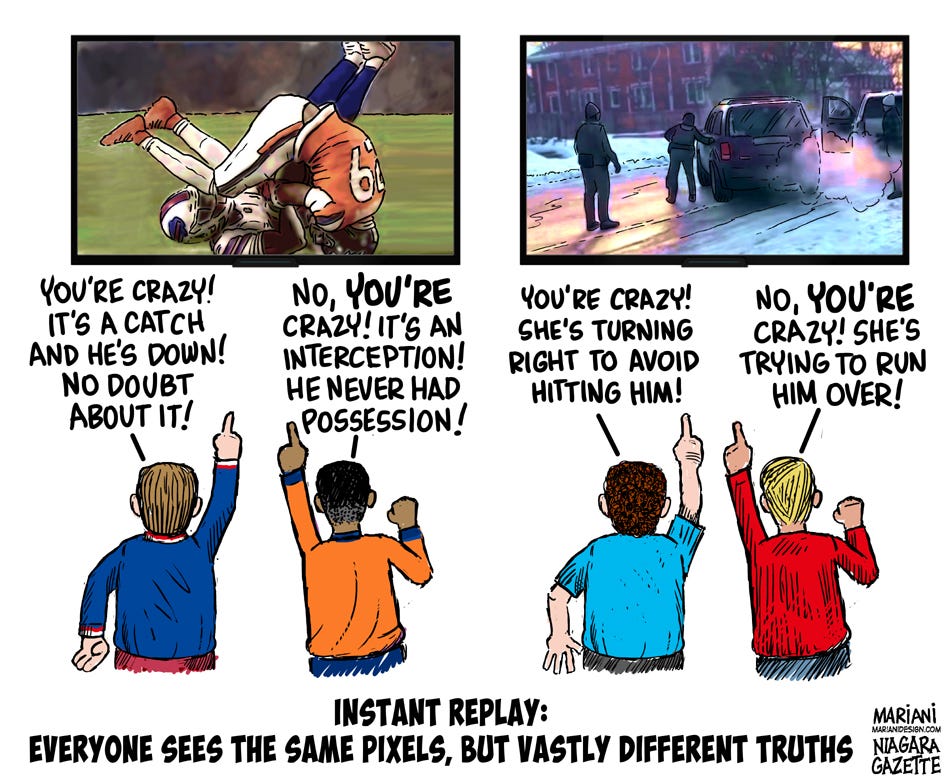
Why do reasonable people look at the same evidence and come to completely different conclusions? This is a question at the heart of epistemology, the branch of philosophy that studies knowledge, belief, and how we justify what we think is true. Philosopher Thomas Kuhn offers a powerful way to understand it. Kuhn (1922–1996) was a historian and philosopher of science who studied how knowledge works. He argued that we don’t interpret the world in a purely objective way. Instead, we operate inside paradigms—frameworks of assumptions, priorities, and rules that shape what we notice and what counts as evidence. When two people live in different paradigms, even identical facts can appear contradictory.
Belief Shapes What We Notice
This is exactly what happens when people interpret the same event differently. Belief shapes perception. In philosophy, this idea is sometimes described as “believing is seeing.” What you already accept as true changes what you notice and how you interpret it. In a related but not identical way, philosophers have said that “faith enables reason.” That doesn’t mean blind belief; it means that having prior assumptions, commitments, or frameworks often guides the way we make sense of the world. In everyday life, it might not be about religion—it could be about politics, sports, or any worldview—but the principle is the same: what we start with influences what we see.
When Stakes Are Different
The stakes matter, too. In one case, the disagreement is about a football game. Who caught the ball? It’s frustrating if you’re wrong, but no one dies. In the other, the disagreement is about a life-or-death event. Did Renee Goode try to turn away, or was she trying to hit the officer? The mechanism is the same: different paradigms produce radically different interpretations, and the more emotionally or morally invested we are in our frameworks, the harder it is to bridge the gap.
Why Philosophy Still Matters
Philosophy matters today because it teaches us to recognize these frameworks, question our assumptions, and understand why others see the world differently. It doesn’t make everyone agree, but it helps explain why disputes escalate and why dialogue often feels impossible. In a polarized age, understanding epistemology—and Kuhn’s idea of paradigms—can help us make sense of disagreement and maybe even find small ways to communicate across it.
This Fan’s Perspective
As a lifelong Buffalo Bills fan, I passionately believed that Cooks’ play was a catch. When his knee hit the ground, it looked to me like the process was complete and the play should have ended there. But I also knew I needed to examine why the officials ruled it an interception. According to referee Carl Cheffers in a pool report, the call was based on three points:
Failure to “Survive the Ground”: While Cooks initially secured the ball, he did not maintain control when hitting the ground.
Process of the Catch: As the receiver was going to the ground, he must maintain possession of the ball, which officials determined he did not do.
Active Defense: McMillian was deemed to have “completed the process of the catch” by gaining control of the ball after it became loose while both players were falling.
As much as I wanted a better outcome for the Bills, I came to understand what transpired. I still felt strongly for my team, but studying the ruling reminded me how our beliefs shape what we see. Here’s the thing I wonder about: had the play been ruled a catch on the field, would video analysis have been enough to overturn the call? We’ll never know. After all, it’s only a game.
"Believe Nothing You Hear...
and Only Half That You See."
-E.A. Poe